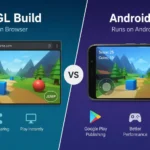
When developing Android games with Unity, one important decision developers often overlook is selecting the appropriate Graphics API. Unity supports multiple rendering backends, but the two most common choices for Android development are Vulkan and OpenGL ES.
Many developers simply leave Unity’s default settings unchanged without understanding how their chosen Graphics API affects performance, battery consumption, compatibility, and overall user experience.
The right choice can help improve frame rates, reduce CPU usage, increase device compatibility, and provide a smoother gaming experience across different Android devices.
In this guide, we’ll compare Unity Vulkan and OpenGL ES in detail, explain their advantages and disadvantages, and help you decide which Graphics API is best for your next Unity project.
What is a Graphics API?
A Graphics API (Application Programming Interface) acts as a communication layer between your Unity game and the device’s graphics hardware.
Whenever Unity renders:
- 3D Models
- Textures
- Lighting Effects
- Particles
- Animations
- Post-Processing Effects
the Graphics API translates Unity’s rendering instructions into commands that the GPU can understand.
The efficiency of this communication directly impacts performance, power consumption, and rendering quality.
What is OpenGL ES?
OpenGL ES (Open Graphics Library for Embedded Systems) has been the standard graphics API for Android devices for many years.
It is widely supported across almost all Android phones and tablets and remains one of the most stable rendering solutions available.
Many older and mid-range Android devices rely heavily on OpenGL ES for graphics rendering.
Advantages of OpenGL ES
- Excellent device compatibility
- Mature and stable technology
- Works on older Android devices
- Easy debugging and troubleshooting
- Reliable across a wide range of hardware
Disadvantages of OpenGL ES
- Higher CPU overhead
- Less efficient resource management
- Limited multi-threading capabilities
- Older architecture compared to Vulkan
What is Vulkan?
Vulkan is a modern low-level graphics API developed by the Khronos Group, the same organization behind OpenGL.
It was designed as the successor to OpenGL and focuses on maximizing GPU performance while reducing CPU overhead.
Unlike OpenGL ES, Vulkan provides developers with greater control over rendering operations, allowing games to utilize hardware more efficiently.
Advantages of Vulkan
- Lower CPU usage
- Better GPU utilization
- Improved multi-threading support
- Higher rendering performance
- Modern graphics architecture
- Future-proof technology
Disadvantages of Vulkan
- More complex rendering pipeline
- Some device-specific issues
- Limited support on older devices
- Potential driver compatibility problems
Quick Comparison Table
| Feature | Vulkan | OpenGL ES |
|---|---|---|
| Performance | Excellent | Good |
| CPU Usage | Lower | Higher |
| GPU Efficiency | Better | Good |
| Battery Efficiency | Better | Moderate |
| Compatibility | Moderate | Excellent |
| Stability | Good | Excellent |
| Older Device Support | Limited | Excellent |
| Future-Proofing | Excellent | Limited |
Performance Comparison
Performance is usually the main reason developers consider switching from OpenGL ES to Vulkan.
Vulkan Performance
Vulkan significantly reduces CPU overhead by giving developers more direct control over GPU resources.
Benefits include:
- Higher FPS in demanding scenes
- Better multi-core CPU utilization
- Reduced rendering bottlenecks
- Improved scalability for large projects
These advantages become more noticeable in graphics-intensive games.
OpenGL ES Performance
OpenGL ES performs well for most mobile games but introduces additional abstraction layers between the game engine and GPU.
This can increase CPU workload and reduce rendering efficiency in complex projects.
For simple games, however, the difference may be minimal.
Winner: Vulkan
Compatibility Comparison
Device compatibility remains one of OpenGL ES’s biggest strengths.
OpenGL ES Compatibility
OpenGL ES is supported by nearly every Android device currently in use.
This makes it an excellent choice for developers targeting:
- Low-end phones
- Older devices
- Emerging markets
- Broad user bases
Vulkan Compatibility
Although Vulkan support continues to improve, some older Android devices still lack full Vulkan compatibility.
Even on supported hardware, driver-related issues occasionally occur.
Developers should always test Vulkan builds on multiple devices before release.
Winner: OpenGL ES
Battery Consumption
Battery efficiency is increasingly important for mobile games.
Because Vulkan reduces CPU workload, devices often consume less power during extended gaming sessions.
Lower CPU usage can also reduce thermal throttling, helping maintain stable performance.
OpenGL ES generally requires slightly more CPU processing, which may result in higher power consumption during demanding gameplay.
Winner: Vulkan
Graphics Quality: Myth vs Reality
A common misconception is that Vulkan automatically improves graphics quality.
In reality, graphics quality depends primarily on:
- Textures
- Models
- Shaders
- Lighting
- Post-processing effects
The Graphics API itself does not magically make a game look better.
However, Vulkan allows developers to implement advanced rendering techniques more efficiently.
How to Switch Between Vulkan and OpenGL ES in Unity
Changing Graphics APIs in Unity is straightforward.
Step 1
Open:
Edit → Project Settings → Player
Step 2
Navigate to:
Other Settings
Step 3
Disable:
Auto Graphics API
Step 4
Add or remove:
Vulkan
OpenGL ES3
Unity allows you to define multiple Graphics APIs and set their priority order.
When Should You Use Vulkan?
Vulkan is an excellent choice when performance is a priority.
Use Vulkan if:
- You are building 3D games
- You target modern Android devices
- You require maximum FPS
- You use advanced visual effects
- You want better CPU efficiency
Examples include:
- Racing games
- FPS games
- Battle Royale games
- Open-world projects
- High-end action games
When Should You Use OpenGL ES?
OpenGL ES remains a strong option for projects that prioritize compatibility.
Use OpenGL ES if:
- You target low-end devices
- You support older Android phones
- You are creating 2D games
- You need maximum stability
- You encounter Vulkan-specific bugs
Examples include:
- Puzzle games
- Educational apps
- Kids games
- Hyper-casual games
- Simple mobile experiences
Common Vulkan Issues in Unity
While Vulkan offers impressive performance improvements, some developers report issues such as:
- Black screens on launch
- Shader compilation problems
- Device-specific crashes
- Rendering glitches
- GPU driver incompatibilities
A popular solution is to support both Vulkan and OpenGL ES3 simultaneously.
For example:
1. Vulkan
2. OpenGL ES3
If Vulkan fails on a particular device, Unity can automatically fall back to OpenGL ES3.
What Does Unity Recommend?
Unity increasingly focuses on Vulkan as the future of Android rendering.
Modern Unity versions are continuously optimized for Vulkan, and many new rendering features benefit from Vulkan’s architecture.
However, Unity still supports OpenGL ES because device compatibility remains important.
Many professional mobile games ship with support for both APIs.
Frequently Asked Questions
Is Vulkan better than OpenGL ES in Unity?
For performance, yes. Vulkan generally provides lower CPU usage and better rendering efficiency. However, OpenGL ES offers superior compatibility with older Android devices.
Should I use Vulkan for 2D games?
Most 2D games work perfectly with OpenGL ES. The performance gains from Vulkan are usually less noticeable in simple 2D projects.
Can I use both Vulkan and OpenGL ES in Unity?
Yes. Unity allows multiple Graphics APIs. Many developers configure Vulkan as the primary API and OpenGL ES3 as a fallback.
Does Vulkan improve FPS?
In many cases, yes. The improvement is most noticeable in graphics-intensive games running on modern hardware.
Final Verdict
Both Vulkan and OpenGL ES are excellent Graphics APIs, but they serve different purposes.
Vulkan delivers better performance, lower CPU usage, improved battery efficiency, and greater scalability for modern mobile games.
OpenGL ES provides unmatched compatibility, stability, and support for older Android devices.
If your goal is maximum performance on modern hardware, Vulkan is the better choice.
If your goal is broad device compatibility and reliability, OpenGL ES remains a strong option.
For most Unity developers in 2026, the best approach is to support both APIs by placing Vulkan first and OpenGL ES3 second in Unity’s Graphics API list.
This setup combines Vulkan’s performance benefits with OpenGL ES’s compatibility advantages, providing the best experience for the widest range of Android users.